Chapter 2. Rabindranath Tagore – Off to the Himalayas

Many years later Rabindranath wrote about his childhood regretting that his mind had almost been frozen in the hands of the servants.

Rabindranath had only a couple of pairs of clothes till he was ten, not having worn socks till then. While his elder brothers used to go to school, a tutor used to visit for teaching the younger children at home as was the culture at that time. One day Rabindranath insisted on going to school like his elder brothers, following which he was admitted to Oriental Seminary School when he grew a bit older. In that school, children used to be physically punished due to which Rabindranath was heart-broken. He was then admitted to another school but the same bad experience continued. Why were these schools called temples of learning, his young mind used to question. At such times the Gayatri Mantra used to give a lot of peace to Rabi. He was attached to this mantra till the end of his life.

Rabindranath’s father, was of a saintly nature. One day he asked Rabi, would you like to go with me to the Himalayas? Being fed up of schools, Rabindranath agreed immediately. Father and son started off on this long journey. We can well imagine how difficult it would have been to travel from the plains of Calcutta to the Himalayas, about a hundred and fifty years ago. This journey in a way changed the direction of Rabi’s life.

The first stop of their journey was at a place which is now known the world over as Shantiniketan. From there they went to Amritsar and stayed there for a few days. They used to visit the Golden Temple daily. The life story of Guru Nanak left a deep impression on Rabi’s mind. Their next stop was Dalhousie, nestled at a height of 7000 feet at the foothills of the Himalayas. During this journey his father used to teach him English, Bengali, Sanskrit, Astronomy and theology. The four months spent in the Himalayas deeply influenced the thought process of Rabindranath. He memorised the entire Ramayan in Sanskrit so much so that he could recite it line by line. Poetry, literature and love for nature was in Rabi’s blood. These were further sharpened by the Himalayas. Although his father gave him a lot of independence, he was also a strict disciplinarian in the sense that some duties had to be observed at all costs. Memorising the Ramayan was one such example.

The world of Rabindranath had changed by the time Rabindranath returned from the Himalayas. He was looked upon with respect by all around. The women who used to visit the Tagore household used to listen to Rabindranath’s stories about the Himalayas and also recitation of the Ramayan in Sanskrit. His mother adored him a lot for his brilliance. At the age of twelve, Rabindranath wrote a long poem titled Abhilasha. It got published in Tattwabodhini Patrika, a prominent magazine of those times.

His father now got him admitted to Saint Xavier’s school. But he left going to school in 1875 at the age of thirteen years.
THE BEGINNING

During the later half of the 18th century, a Brahmin by the name of Panchanan Thakur, used to supply goods and items of daily necessities to the British ships which used to dock in the seaports of Bengal. Although he was a Brahmin, but due to his immense wealth and influence, he was called Thakur.

The ancestors of Panchanan Thakur had settled down in Kannauj about a thousand years back. They were Daksh Brahmans but a member of the family had smelled the aroma of mutton being cooked in the house of one Pir Ali. From then onwards, the family started being called as Pirali Brahmans. This was a type of social ostracisation of the Thakur clan. Englishmen could not pronounce Thakur properly, so they used the more pronounceable word “Tagore” instead.

The extremely wealthy Thakur family were quite influential in Calcutta of the 19th century. Rabindranath, the fourteenth son was born in this family to Debenndra Nath Thakur and Sharda on 7th May 1861 in the palatial house of the Tagores’ in Calcutta.

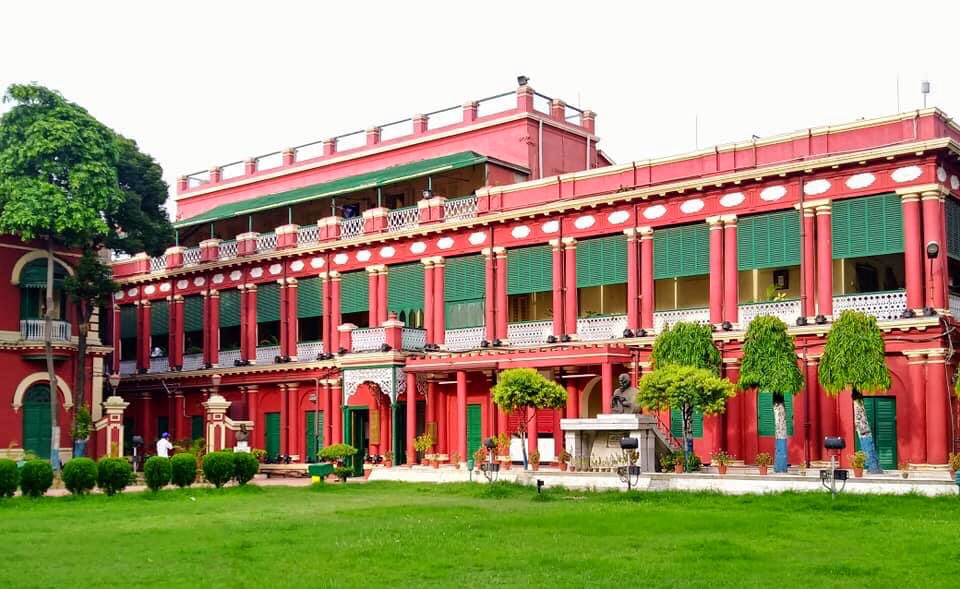
Jorasanko, the anscestral house of the Tagores’ in Kolkata

Debendranath’s father, Dwarkanath had earned a lot of wealth during his lifetime. His lifestyle was no less than a king because of which he was called Prince Dwarkanath. He had thousands of acres of land, sugar mills, tea factories, jute mills, coal mines and hundreds of cargo ships and boats. He cultivated silk, spices and indigo in his estates. All these businesses were conducted under the banner of Carr, Tagore & Co.

Prince Dwarkanath had visited Europe on his own ship. He was the first Indian to have met the Queen of England. He founded many well known institutions in India like the National Library, Kolkata; and the Union Bank of which he was a founder Director.

It was a period of Renaissance in Bengal dominated by many well known social reformers like Raja Ram Mohan Roy, and Ishwar Chandra Vidyasagar. Dwarka Nath Thakur was a close friend of Raja Ram Mohan Roy.

Dwarkanath’s son, Devendranath did not have any interest in expanding the vast commercial empire of his father. He was of saintly nature and became the chief patron of the Brahmo Samaj after the death of Raja Ram Mohan Roy.

Having given birth to fourteen children, Sharda Devi used to maintain indifferent health. Consequently, Rabindranath was brought up mainly in the hands of servants. Rabindranath felt the loss of mother’s affection throughout his life. The servants used to be quiet perturbed due to the daily mischiefs of Rabindranath. In order to control him, one of the servants narrated the story of Sita haran to him and drew a circle with a chalk around Rabindranath. The servant told him that if you come outside this circle, Ravan will take you away.

Tiger’s Nest

Our last day in Bhutan was perhaps the best day we spent in the Land of  the Thunder Dragon. This is the day we visited the Tiger’s Nest, which is one of the most widely recognised and extraordinary tourist spots in Bhutan.We started from our hotel in Paro at 7.30 am as we wanted to cover at least a portion of our journey till the sun came up. We were at the car parking, from where the hike starts, in about 20 minutes.

We started the uphill hike to Tiger’s Nest at 8 am after purchasing the entry tickets for Rs. 500 per head. Students travelling to Bhutan should remember to carry their school/college id cards with them as 50% concession is given on tickets to students. The facility is extended to students from India as well.We did not opt for horses for our trip as  I did not find very encouraging reports on the internet. Also the ponies take you only half way up the hill and are also not permitted on the climb down. One such horse  trip costs Rs. 600 per head. The tickets are only for entering the monastery. One can still go up the entire path to the entry of the monastery without the entry ticket.

Paro Tatsang Monastery or Tiger’s Nest is a Buddhist temple complex which was built in 1692. The monastery hangs on a precarious cliff at about 10240 ft. The rock slopes are very steep and almost vertical. The monastery buildings are built into the rock face. I wondered at the expertise of the people who built this magnificent edifice in such a difficult location.

It is believed that Guru Rinpoche (Padmasambhava) flew to this location from Tibet on the back of a tigress to tame a Tiger demon. 

The temple complex was built around the cave where Guru Padmasambhava had meditated for three years, three months, three weeks, three days and three hours in the 8th century. Padmasambhava is credited with introducing Mahayana school of Buddhism to Bhutan. The cave is opened only once a year for public view.

The path to the monastery passed through a dense pine forest that was colourfully festooned with prayer flags and moss covered rocks. The hike  all along was  very scenic with the gurgling sounds of streams and waterfalls breaking the silence.  Different kinds of flowers and rock formations accompanied us all through. We met people of various nationalities all along the way, some carrying small babies on their backs. After about half an hour of hiking, we started getting glimpses of the magnificent Tiger’s Nest which came closer and closer as we covered the distance.

3714E523-D047-456D-958C-9D70993551C5.jpeg

The hike was to me one of moderate difficulty with most of the path consisting of stone, gravel and dust. The last part of the journey consisted of climbing up and down around 700 stairs. I could cover the entire round trip of 6.4 kms in 6 hours. The elevation gained from the base was about 1700 feet. Many people complete the journey only up to the cafeteria which is mid way and come back. I also had doubts whether I would be able to complete the hike successfully as I had read blogs about the difficult terrain. However, I did not find the hike very difficult or dangerous. However,  I had to take breaks every few minutes to gather my breath and energy. Also the two bottles of water  that I carried with me were  fully consumed. The walking stick which I had taken on rent for Rs.50.00 at the base proved to be very useful.

Near the beginning of the trail we came across a water powered prayer wheel, which was revolving continuously powered by the crystal clear water from a flowing stream. There was the sweet chime of a bell with each rotation of the wheel. The water that is touched by the wheel is said to have become blessed and carries its purifying powers into all rivers and lakes that it flows into.

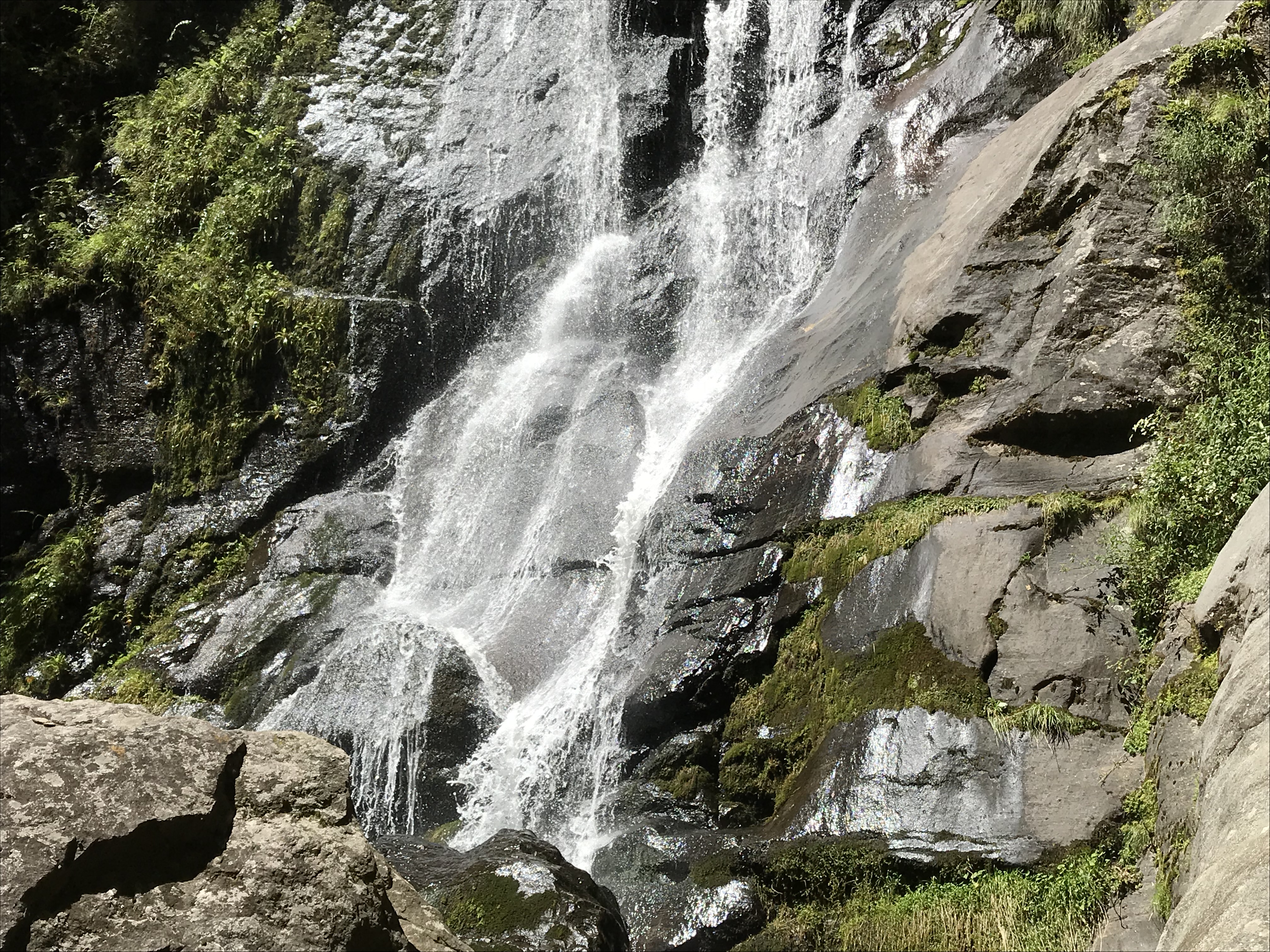
At the end of the trek and just before climbing up the stairs to Tiger’s Nest, suddenly there appeared a huge waterfall with a drop of around 200 feet. We had to cross a small bridge here to reach the stairs to climb up to the temple complex.

The monastery building consists of four main temples and residential quarters for the monks, beautifully designed to fit into the granite ledges and the rocky terrain. All the buildings are interconnected through steps and stairways made in rocks. The monastery is so precariously perched that it appeared that it was clinging to the side of the mountain like a wall lizard.

We were asked to deposit all our belongings, bags, mobile phones and cameras, before entering the monastery.

In 1998, a fire broke out in the monastery destroying many valuable paintings, artefacts and statues. However, the statue of Guru Rinpoche remained intact. The temple was restored in 2005.